Shop Now
- ALUMINIUM HORSESHOES
- STEEL HORSESHOES
- THERAPEUTIC HORSESHOES
- HORSESHOE NAILS
- RASPS
- TOOLS
- WORKSHOP EQUIPMENT
- CARE
- MUSTAD MERCHANDISE
Blog Archives
Stay Connected Blog Categories
Farrier TipsTips and Tricks
Equine InfoHoof Conditions
General
Guest AuthorsCarl O'Dwyer
|



How To Handle Maternity Leave As A Farrier
Careers in hoof care are built on skill, resilience, and adaptability, and that doesn’t change when life does. Supporting farriers through every stage of their journey means recognising the realities they face, both inside and outside the forge.
I’ll start by saying this: I’m not sure anyone is ever truly qualified to write about how to handle maternity leave as a farrier.
“Handling it” implies you’ve figured it all out — that there’s a neat formula, a checklist, and if you just follow the steps, everything will be easy. If someone has cracked that code, please do get in touch. I’d love to know how.
What I can share is what I’ve tried, what hasn’t worked, and how I’ve managed to pull off the appearance of being in control — while not always being sure whether I’ve brushed my teeth or even put the right shoes on before leaving the house. (For the record, turning up to your first job in mismatched Crocs is absolutely something I would never do. Obviously.)
At the time of writing, I’m three weeks postpartum, parked on the sofa with my newborn daughter, Maeve, half-using her as a laptop stand while debating whether it’s socially acceptable to eat Nutella straight from the jar because I forgot the spoon. At this point, I’m about as reliant on Nutella as Maeve is on me — and honestly, no shame in that.
Configuring Your Maternity Leave
Every farrier’s career and business looks different, and that has a huge impact on what pregnancy and maternity leave will realistically look like.
For most of us, maternity leave isn’t clear-cut. Unlike many industries, there’s often no formal structure, no guaranteed income, and no simple way to step away for six months and return exactly where you left off. I know there’s currently a push in the UK to gain better recognition and support from governing bodies — and frankly, it’s overdue, but this is great news.
Most women I know have taken an integrated approach: slowing down gradually, adjusting workloads, and returning in stages. The idea of taking six months completely off and then jumping straight back into six full sets a day is enough to make my legs give way just thinking about it. You’d have to hoover me up off the floor!
Your baby might happily snooze in a pram while you crack on with work. Or they might be a tiny, wonderful ball of pure chaos who makes concentration impossible — meaning childcare becomes a necessity far earlier than planned, along with a heavy dose of mum guilt. It’s different for everyone, and none of it is wrong.
The Pregnancy Journey
Pregnancy has a way of inviting opinions — whether you asked for them or not.
I was questioned more than once about whether I felt guilty continuing to work while pregnant, as though risking my income wasn’t also a concern. The reality is simple: if I don’t work, I don’t get paid. And honestly, that’s nobody else’s business.
Eventually I had to stop working entirely. Which meant getting rid of all of my clients. Everyone. Then, when I slowly began again, I felt guilty reaching out to old clients — I didn’t want to steal them back off the new farrier. Starting again can feel daunting.
Some friends have employed day workers to bridge the gap, allowing them to reduce physical strain during pregnancy without restructuring their entire business. That same support can make returning to work smoother, while maintaining cash flow and client relationships. More than anything, having another farrier to lean on — practically and emotionally — can make a huge difference.
Getting Back Into Shoeing After Pregnancy
Not shoeing a horse for five weeks felt like five years. I genuinely wondered if I’d forgotten which end of the horse was which — or if the industry had somehow evolved beyond recognition in my absence.
For many of us, farriery isn’t just a job — it’s a big part of our identity. The thought of losing that is frightening. But the truth is, horseshoeing hasn’t changed dramatically in hundreds of years. A few weeks (even with baby brain) won’t undo your skills.
After the birth of my first daughter, Alice, I shod my first pair of fronts when she was just ten days old. It was reassuring to know my hands still remembered what to do — but standing up afterwards was a sharp reminder that while my brain might’ve been ready, my body definitely wasn’t. Please listen to your body. Relaxain is great for helping your body with childbirth — less so for your spines structural integrity whilst working. Just ask my MRI.
Having a husband who’s also a farrier meant I could ease back in gently, help when I could, and occasionally offer unsolicited advice, tell him he was doing it all wrong but that I was going home to eat biscuits anyway. Support matters, and having another farrier there to back you up is amazing. Especially when you don’t know if you’re going to breakdown physically, emotionally.. or both.
Work Life Balance As A Mother And Farrier
Balancing work, family, and recovery is hard — sometimes it feels impossible. I’ve learned that setting goals helps me remember that I’m still more than “just” a mum.
Some goals are ambitious.
Some are… realistic.
For example :
- Remember to put deodorant on today.
- Make the perfect fishtail bar shoe in the 45 minutes of free time you’ve got.
After my second child, I set a longer-term goal of working towards my AWCF, using whatever downtime existed — usually between 11pm and 2am — to study or plan. Actual shoemaking was trickier. Our “nursery” was separated from the anvil by a fridge panel, so nighttime forging wasn’t exactly practical.
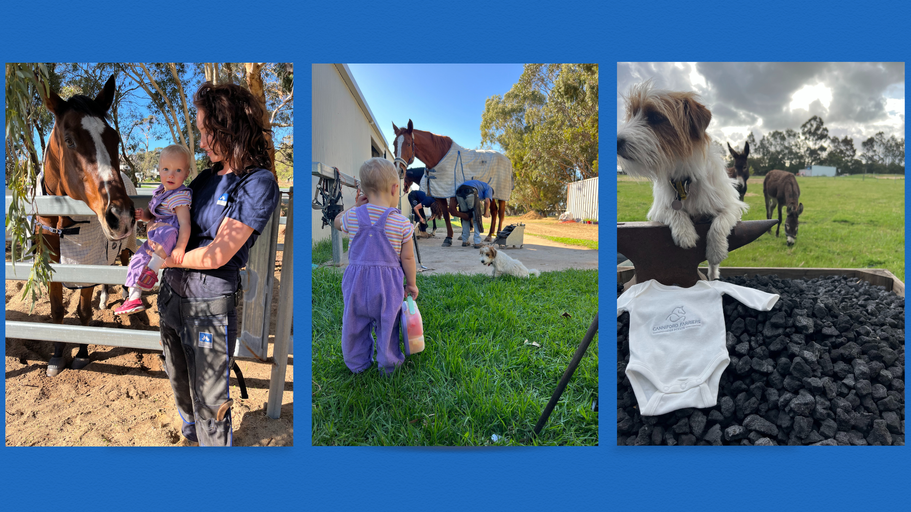
You learn to trust that things will work out, because they have too. You figure out how to shoe a horse with a baby crawling nearby, or trim donkeys while juggling a toddler and a newborn. And somehow, you get out the door — which, honestly, is often the hardest part.
There’s no single right way to approach maternity leave as a farrier. It’s messy, exhausting, emotional, and deeply personal. But it’s also proof of just how adaptable, resilient, and capable farriers are. And great farriery isn’t just about the work you do at the anvil; it’s about the people behind it.
You won’t forget your craft. You won’t lose your place. And you’re doing far better than you think — even if today’s biggest achievement was remembering your shoes.